Drain Cleaning in Englewood and Fort Lee, NJ: Why Your Clog Keeps Coming Back
In Englewood and Fort Lee, the most common drain cleaning call our plumbers take starts with the same sentence: "it keeps clogging no matter what I pour down it." Here is the secret behind that sentence: the clog never actually left. A drain that re-clogs on a schedule has a structure inside the line (a hair-and-biofilm mat just past a bathroom trap, a hardened grease sleeve coating a kitchen branch, scale or debris in a shared stack or main), and every plunge or bottle of chemical merely opens a narrow channel through it. Water flows for a few weeks, the channel catches new debris, and the "new" clog arrives on schedule. What ends the cycle is removing the structure itself: an auger that extracts rather than trims, hydro jetting that scours the pipe wall back to bare, and, for repeat offenders, a camera look at what is actually in the line. Here is how to read your clog's pattern the way our plumbers do, what the local housing makes of it, and the one pattern that outranks all the others.
The Repeat Clog Is a Message, Not Bad Luck
A one-time clog is an event: something went down that should not have, it got stuck, it got removed. A clog that returns every month or every season is a condition: there is a structure in your pipe, and everything you send down the drain is auditioning to join it. The giveaway is the rhythm. Clears-then-slows over days or weeks means a partial obstruction is still in place, filtering your wastewater like a net, and the location of the trouble maps neatly to what the drain carries, which is why the fixture tells us half the story before any tool comes out.
Drain Cleaning in Englewood and Fort Lee: What We See Here
Two towns, two very different drain problems, one phone number.
Englewood's housing runs old and proud: prewar colonials and tudors with original cast iron and galvanized drain lines that have narrowed for seventy years. In pipes like those, clogs are rarely just clogs; they are the rough interior of an aging line catching what smooth pipe would pass. It is also why we take the chemical bottle personally here: caustic cleaner sitting in a fifty-year-old trap accelerates exactly the corrosion that is causing the problem. Our Englewood calls lean toward whole-line solutions (jetting, camera verification, honest talk about a line's remaining life), and our Englewood plumber page covers how we work in town.
Fort Lee is the opposite skyline: towers and mid-rises where your drain is one branch of a shared stack serving dozens of kitchens above and below you. A unit that clogs on a schedule there is often downstream of a stack problem it did not cause, and the classic Fort Lee symptom is drama at your fixture when a neighbor drains theirs. The camera settles whose line it is before anyone opens a wall, which keeps unit owners, boards, and managers out of arguments; our Fort Lee plumber page has the building-side details. Either town, the dispatch is the same: our plumbers are minutes away, with pricing explained before any work begins: (888) 886-4784.
Read Your Clog's Pattern
The bathroom sink or shower that clogs every month or two. A hair-and-soap mat bonded with biofilm, anchored just past the stopper or trap. Pulling hair off the top shaves the mat; the anchor stays. The fix is extraction: stopper assembly out, auger through the trap zone, the mat removed whole rather than trimmed.
The kitchen sink that clogs every few months. Grease went down warm and liquid, cooled inside the pipe, and built a sleeve that narrows the line year after year, with food solids and detergent scum embedded in it. Plunging punches a channel through the sleeve; the sleeve remains. (Hot water and dish soap do not melt it away; the grease re-solidifies a few feet further down.) The sleeve comes out with hydro jetting, which scours the pipe wall back to bare instead of drilling one more temporary tunnel.
The toilet on the weekly plunger plan. A partial trapway obstruction (the classic lost toy that never fully left), a tired low-flow flush that needs more help than it gets, or a branch problem downstream. Ten minutes of diagnosis ends months of plunging.
The pattern that outranks everything: the whole home joining in. Multiple fixtures slowing together, tubs gurgling when the toilet flushes, the lowest drain burping back. That is not a drain; that is the main line or the stack, narrowed by grease, scale, wipes (not flushable, no, not that brand either), or roots, and it is practicing for a backup. A backup delivers contaminated water to the lowest level, and if it wins the race, our guide on flooded basement first steps covers that very bad morning. Better to clean the main this week.
Why the Liquid Cleaner Keeps Losing in Englewood's Older Pipes
Every recurring-clog household owns the bottle, so here is the honest chemistry. Caustic drain cleaners dissolve the organic material they touch, and they do: at the top of the clog, where they open a channel, declare victory, and drain away. The mat or the sleeve underneath survives. Meanwhile the chemical sits in the trap generating heat that stresses PVC joints and accelerating corrosion in older metal lines, and a standing drain full of caustic is a hazard for whoever opens it next (always tell your plumber what went down). One bottle on a minor slow drain is a shrug. The monthly bottle subscription is a sign the drain needs a real fix, and in seventy-year-old pipe it is actively shortening the line's life.
What Actually Ends the Cycle
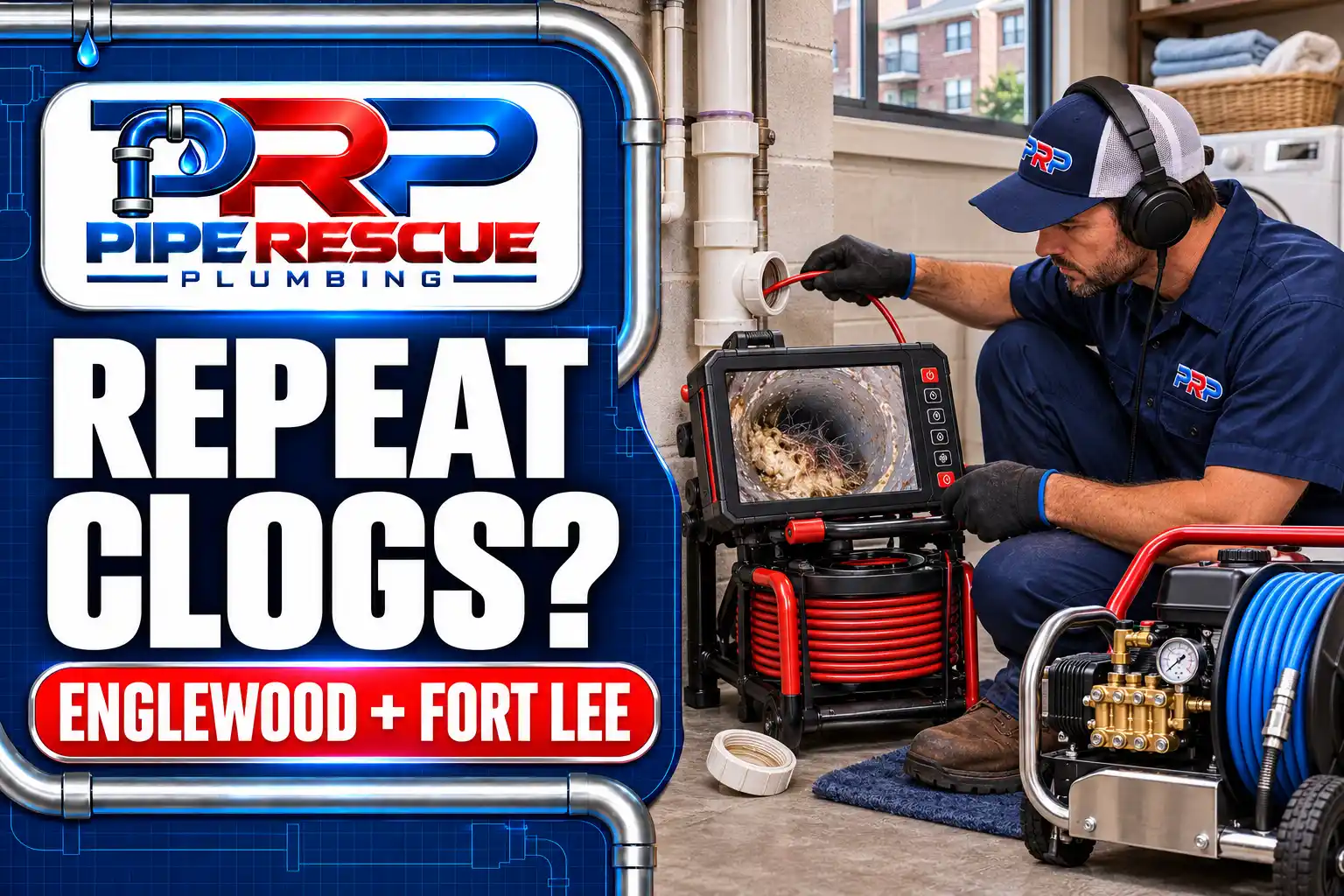
The professional sequence is short and deliberately boring. Match the tool to the cause: an auger extracts trap-zone mats and trapway objects; hydro jetting scours grease sleeves and scale from branch lines, stacks, and mains back to the pipe wall. Verify instead of hoping: lines with a repeat history get a camera inspection, which separates a simple recurring clog from the conditions it can mask (a bellied section that pools, an offset joint catching solids, root intrusion at an old connection), and in multi-unit buildings it settles whose line the problem lives in before anyone opens a wall. Then fix the inputs, which costs nothing: strainers in sinks and showers, a hair catcher in the tub, grease into the trash, wipes into the bin. Most of what our drain cleaning service removes was an avoidable deposit, and our plumbers will say so honestly, with pricing explained before any work begins. One more honest note for heavy-cooking households and the restaurants along both towns' avenues: a kitchen line that feeds a serious stove earns a preventive jetting every year or two, because the grease sleeve is not a possibility there, it is a schedule, and the planned cleaning always costs less than the Saturday-night emergency version.
The Bottom Line
A clog that comes back never left: monthly bathroom clogs are a hair mat past the trap, cyclical kitchen clogs are a grease sleeve, the weekly-plunger toilet has a trapway or flush problem, and a whole home slowing down together is a main or stack rehearsing a backup. Skip the bottle, match the tool to the cause, and camera the repeat offenders. For drain cleaning in Englewood, Fort Lee, and the surrounding towns, our plumbers arrive with the auger, the jetter, and the camera on the same truck: Pipe Rescue Plumbing, (888) 886-4784, with same-day emergency response and pricing explained before any work begins.
Frequently asked questions
Do you handle drain cleaning in Englewood and Fort Lee the same day?
Yes. Englewood and Fort Lee sit minutes from our Englewood Cliffs base, so same-day drain cleaning is the norm and true emergencies (a main backing up, a fixture out of service) are prioritized around the clock. Pricing is explained before any work begins, and the truck carries the auger, the hydro jetter, and the camera, so the visit that diagnoses the line is the visit that fixes it.
Why does my drain keep clogging in the same spot?
Because a partial blockage is still in the line, and every remedy so far has only opened a channel through it. Bathroom drains regrow clogs around a hair-and-biofilm mat anchored past the trap; kitchen lines re-narrow inside a hardened grease sleeve; mains and stacks re-choke on scale, wipes, or roots. The channel catches new debris and closes again, on a schedule. Removing the structure itself, with an auger or hydro jetting matched to the cause, is what breaks the cycle.
Why doesn't liquid drain cleaner fix my clog?
Caustic cleaners dissolve the top of a clog, open a narrow channel, and drain away, leaving the mat or grease sleeve in place to regrow. Along the way they generate heat that stresses plastic joints and accelerates corrosion in older metal lines, which matters in prewar housing stock, and a drain left standing with chemical in it is a hazard for whoever works on it next. Needing a bottle monthly means the blockage needs mechanical removal, not more chemistry.
What's the difference between snaking and hydro jetting?
A snake or auger is a cable that bores into or hooks a blockage and pulls it out: ideal for hair mats, trapway objects, and single soft clogs. Hydro jetting is high-pressure water that scours the entire pipe wall clean: the right tool for grease sleeves, scale, and lines that keep re-narrowing, because it removes the structure clogs rebuild on. Repeat-clog lines usually need jetting, and the camera confirms which tool the line actually needs before we commit you to either.
My apartment drain clogs when my neighbor runs water. What does that mean?
That is the classic shared-stack symptom in buildings like Fort Lee's towers: your fixture is one branch of a vertical stack serving many units, and a narrowing somewhere in the stack makes one unit's drainage appear at another's fixtures as gurgling, slow draining, or backup. The fix belongs at the stack, not your sink, and a camera inspection establishes whose line carries the problem before anyone opens a wall, which keeps owners, boards, and managers aligned on responsibility.
How do I know if my main sewer line is clogging?
The main announces itself house-wide: multiple fixtures draining slowly at once, gurgling from tubs or toilets when other fixtures run, water appearing at the lowest drain, toilets that bubble. Any of those, and especially water rising in a floor drain without anyone running water, means stop using water and have the main cleaned now, because the next stage is a backup delivering contaminated water to your lowest level. House-wide symptoms are a this-week call, not a someday one.
Written by the Pipe Rescue Plumbing team.